Author Archives: Doug

Strikeouts and the changing face of slugging

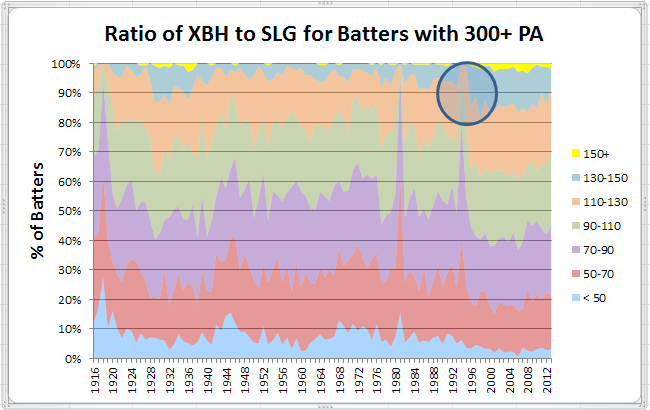
In a recent quiz, I happened to stumble upon a tiny subset of hitters, namely those represented by the yellow area in the extreme upper right-hand corner of the chart below. In that post, I noted the recent increase in the number of such hitters and speculated on what might be causing this uptick.

More on batters with a high XBH to SLG ratio after the jump.

Ratio of XBH to SLG 1916-2013

Continue reading

Quiz – Modern Hitters (stumped)

For 101 major league seasons (1901-2001), the players below were the only hitters to achieve a certain seasonal batting feat. In 2002, three more players achieved this distinction and, since 2002, 5 more players have done this a total of 7 times.

What is this batting feat peculiar to modern day hitters?

Rk Player
1 Joe Medwick
2 Zoilo Versalles
3 Hal McRae
Provided by Baseball-Reference.com: View Play Index Tool Used
Generated 10/31/2013.

Hint: Versalles’ season is the one you’re thinking of.

Don’t know whether I stumped you or just no interest. Anyway, the solution is that these players and the others from the current century all have a low slugging percentage relative to extra-base hits. In particular, they are the only players since 1901 having a season with an extra-base hit total of over 160 times slugging percentage. The seasons are after the jump.
Continue reading

Quiz – off-season blues (solved)

The off-season is upon us (sigh). Yeah, I know. It’s a letdown.

For some distraction, here’s a quirky bit of trivia. The players below have the only seasons since 1901 with a particular batting feat. And, if you look closely, only one of these players has had such a season in the expansion era. What is this feat that has become so rare?

Hint: each of these players accomplished this feat only once

Congratulations to Christopher Kamka! He correctly identified that these are the only players having a qualifying .300/.400/.500 season with an equal number of HRs and triples. Those seasons are after the jump.
Continue reading

Game 6 Preview

The Red Sox go for all the marbles tonight. But to do it, they’ll have to find an answer to young Michael Wacha. In game 2, Wacha became the 16th pitcher to start and win 4 games in a single post-season. With another W tonight, Wacha can become the first starter to reach 5 (Randy Johnson won 5 games in 2001, one of them in relief; before recording the first decision of his regular season career, the Angels’ Francisco Rodriguez won 5 post-season games in 2002, all in relief). Wacha would also become the first starter with more career wins in the post-season than in the regular season.

For the Cardinals, it’s a bigger hill to climb. They will be trying to come back from 3-2 down, on the road. No team has done that since the 1979 Pirates (who came back from 3-1 down).

More after the jump.

Continue reading

Top World Series WPA Games

The top WPA performance so far in the 2013 Series goes to David Ortiz, with a 0.386 score in a losing cause for the Red Sox in game 2. That mark just misses making the table below for the top WPA games by players on the winning and losing teams in each game of the World Series.

Game Winning Team Date WPA Losing Team Date WPA
1 Kirk Gibson 1988-10-15 0.870 Larry Walker 2004-10-23 0.600
2 Ed Sprague 1992-10-18 0.669 Eddie Murray 1979-10-11 0.392
3 Scott Brosius 1998-10-20 0.624 Home Run Baker 1914-10-12 0.370
4 Charlie Keller 1941-10-05 0.829 Bobby Tolan 1972-10-19 0.538
5 Harry Hooper 1915-10-13 0.617 Tom Tresh 1964-10-12 0.410
6 David Freese 2011-10-27 0.964 Josh Hamilton 2011-10-27 0.547
7 Hal Smith 1960-10-13 0.636 Yogi Berra 1960-10-13 0.383
Deciding Hal Smith 1960-10-13 0.636 Fred Schulte 1933-10-07 0.404
Home Team David Freese 2011-10-27 0.964 Pedro Feliz 2009-11-01 0.484
Visiting Team Charlie Keller 1941-10-05 0.829 Larry Walker 2004-10-23 0.600
Provided by Baseball-Reference.com: View Play Index Tool Used
Generated 10/27/2013.

A look back at some memorable Series games after the jump.

Game 4 Preview

After the twists and turns (and stumbles) of game 3, it’s on to game 4. What other series have run the same course of this one?

This is the 52nd World Series in which the the first two games were split and, of those, the 27th in which the home team won game 3. That game 3 winner went on to win 17 of those 26 earlier series, a .654 winning clip. While there have been 26 previous series that fit this year’s mold, this is only the 5th time it’s happened since another memorable series involving the Red Sox – their 1975 tilt with the Big Red Machine.

More after the jump on other series that have followed the pattern of the 2013 Classic.

Continue reading

Quiz – World Series Preview (solved)

The 2013 World Series is expected to be the first in 55 years with a particular quirk. Something happened in the 1958 series between the Braves and Yankees that has not occurred in any subsequent World Series. Until this one.

What is this unusual occurrence?

Congratulations to John Autin! He identified that this is the first World Series since 1958 in which the game 1 starters both have 95 career wins with a .600 career winning percentage, and have both previously appeared in a World Series clinching game playing for their current teams.

In fact, neither of those two answers was the unusual occurrence I had detected. So, I’ll add a third answer – that Adam Wainwright and Jon Lester, like Whitey Ford and Warren Spahn in 1958, are both 29 years old or older and, unlike 18 other pairs of age 29+ game 1 starters since 1959, Wainwright and Lester have both played for only one franchise.

Pitching paralysis, or “if it’s the 8th inning, this must be the setup man”

On September 1st, Houston’s rookie starter Brett Oberholtzer shut out the Mariners 2-0 as the Astros became the last team to record a complete game in the 2013 season. This is the first time in 3 years that every team has recorded a complete game.

While it’s certainly not news that complete games have been on a seemingly never-ending decline, I thought it would be interesting to take a statistical look at some of the resulting impacts on the game.

More on the complete game and the ever-changing dynamics of pitching after the jump.

Continue reading